Productivity
AI Traffic: The Cohort Your Dashboard Sees But Isn't Looking At

Rishan Chopra
Founder
There is a new kind of traffic arriving on your website.
It does not come from a query you bought. It does not come from a campaign you ran. It does not come from a referral path your attribution model was designed to track. It comes from someone who asked ChatGPT, or Claude, or Perplexity, or Gemini, or Copilot — "what's the best X for Y?" — and then clicked the link the model handed them.
The industry has started calling this AI traffic. Some people call it AI-audiences. The exact label is going to settle out over the next year or two and I have no particular interest in being the person who decides which one wins. What I do want to argue, in this series, is that whatever we call it, it is the most consequential change in paid acquisition since the rise of paid social — and most paid marketing teams are looking past it not because they can't see it, but because they aren't yet looking at it the right way.
A subtle but important distinction. Let me unpack it.
What Your Dashboard Already Knows
In most modern analytics setups — Google Analytics 4 in particular — AI-referred traffic is, in fact, tracked. You can see it. The referrers from ChatGPT, Perplexity, Claude, Gemini, and Copilot do show up. They land in the Referrals channel in the default channel grouping, alongside traditional referral traffic from publishers, partners, and links elsewhere on the web. If you scroll through the source/medium report in GA4 right now, you will find chat.openai.com / referral, perplexity.ai / referral, and the rest sitting there.
So the problem is not that the traffic is invisible. The problem is that the default reporting puts it on the same line as every other referral source, in a channel grouping that most marketing teams haven't materially looked at in years. The data is there. The attention isn't, and the custom view that would let you compare AI-referred traffic to your paid channels, your organic search, and your direct visits as a peer category — that view is one your team has to build. Out of the box, you don't get it.
That distinction matters because it tells you what work to do. This is not a measurement-infrastructure problem. You don't need a new analytics platform. You need a custom report — a new line on the dashboard, a new entry in the channel grouping, a new comparison set in the weekly review — that pulls AI-referred sessions out of the broader Referrals bucket and treats them as a first-class cohort you actually monitor.
For some teams that work takes an afternoon. For others, with cleaner attribution requirements or cross-platform measurement, it takes a sprint. The expensive part isn't the configuration; it's the institutional decision to start looking at this cohort with the same care you look at paid search.
The cost of not doing it is not that the traffic is invisible. The cost is that it is invisible to your team — buried in a tab nobody opens, hidden in a noise bucket nobody benchmarks against paid CAC, missing from the budget conversations where the data should be doing the loudest arguing.
The Shift Has Already Happened
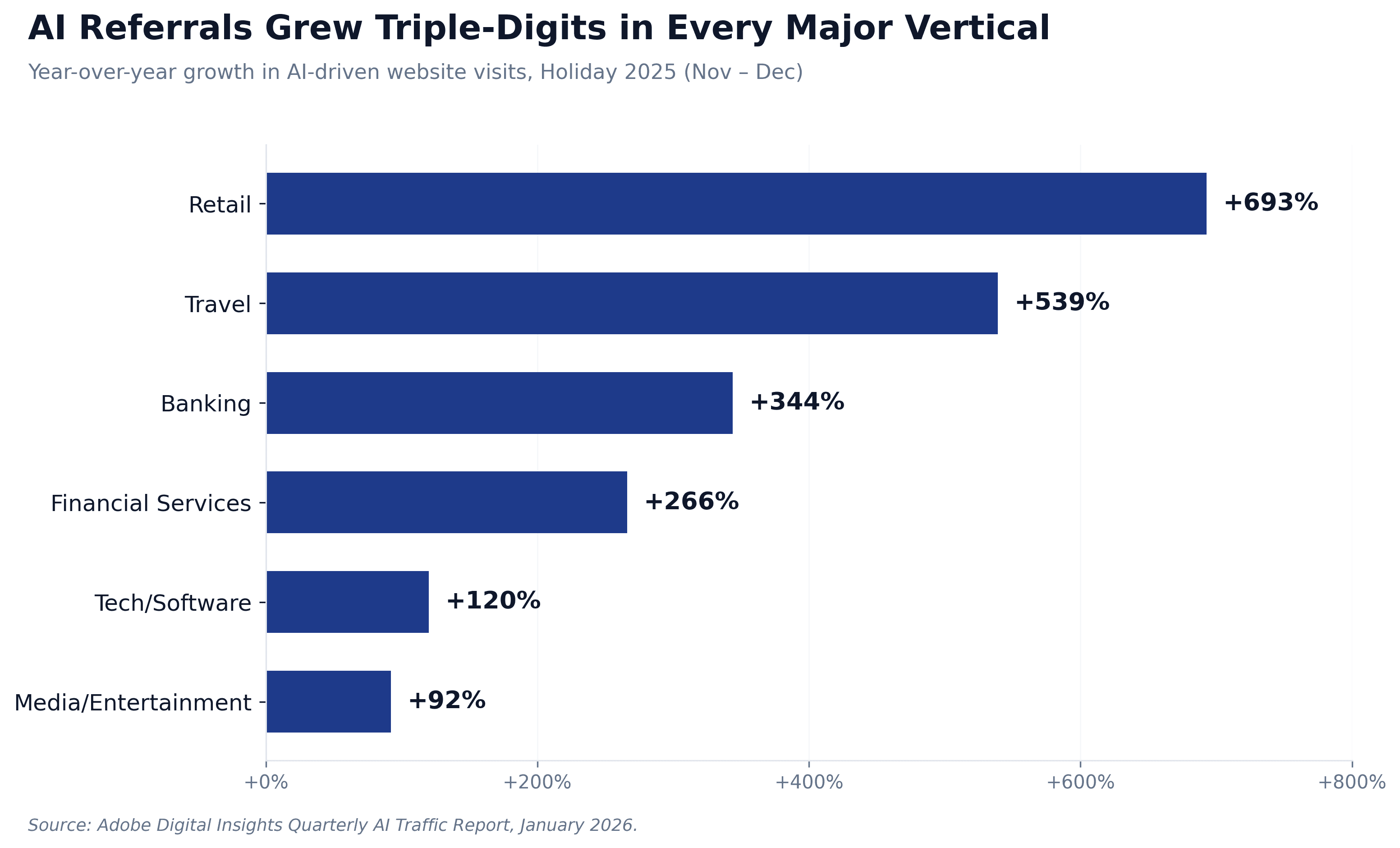
In January 2026, Adobe Digital Insights published its first Quarterly AI Traffic Report. The headline numbers, drawn from over a trillion U.S. retail site visits, are not subtle. Every major industry Adobe tracks is seeing at least 92% year-over-year growth in traffic referred by AI Assistants.
Retail: +693%
Travel: +539%
Banking: +344%
Financial Services: +266%
Tech/Software: +120%
Media/Entertainment: +92%
This is not a curve that is bending. It is a curve that has already bent, and most marketers are looking at a chart that doesn't include it as a first-class line. You don't have to take Adobe's word for it. Cloudflare's Radar reports have been tracking the explosion of AI-related crawl and referral traffic across their network for over a year. Similarweb's data on direct visits to ChatGPT, Perplexity, and the rest tells the same story: the assistants are now top-of-funnel destinations at a scale that rivals — and in some segments exceeds — traditional search verticals. Gartner has forecast a meaningful decline in traditional search engine query volume by 2026 as AI Assistants intercept demand higher up the journey.
The point is not the precise size of any single number. The point is the direction and the slope. AI traffic is no longer rounding error. It is the fastest-growing source of high-intent visitors that paid marketing teams have ever seen, and it is growing faster than anyone planning a 2026 budget has accounted for.
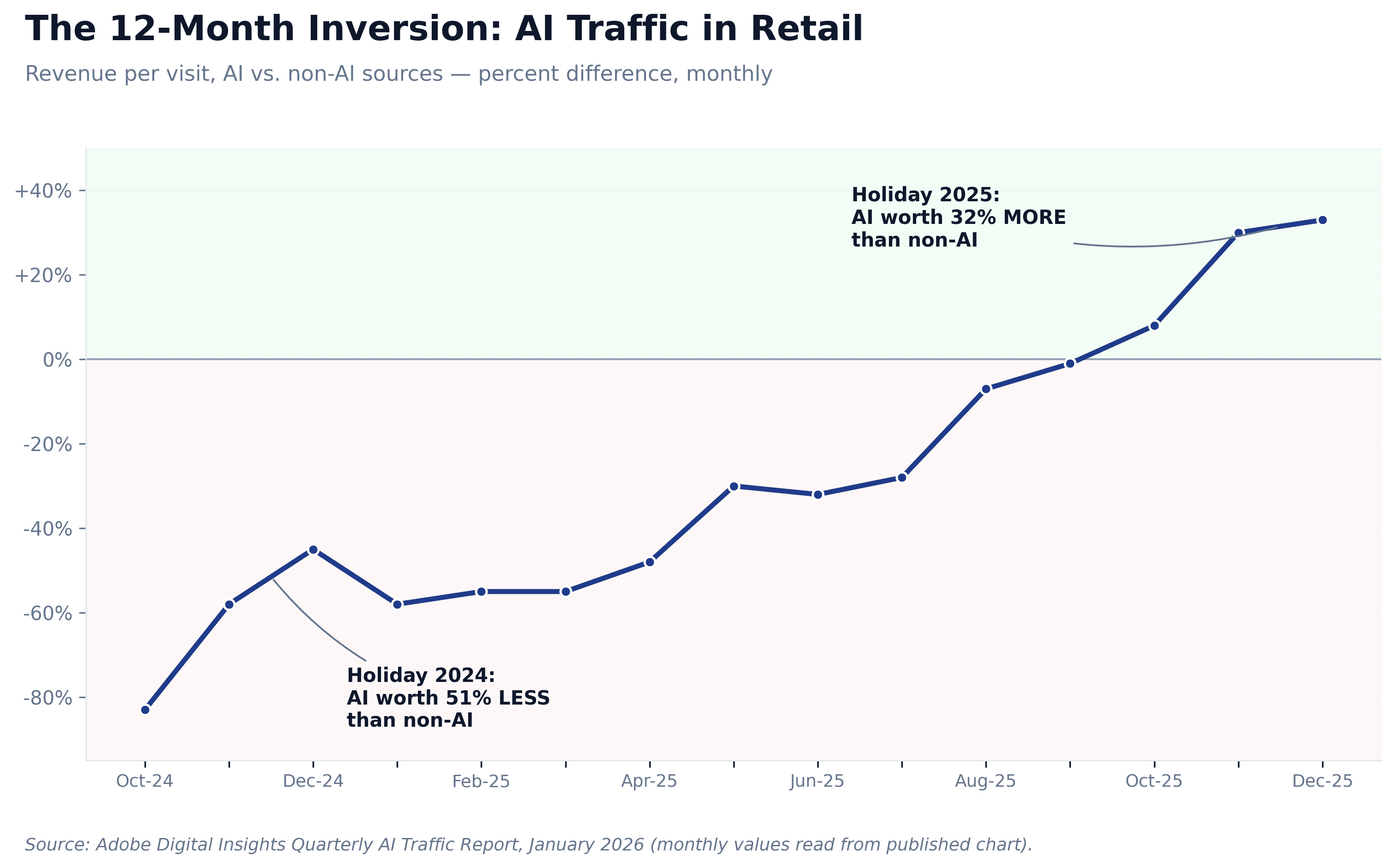
But growth is only half the story. The other half — the one I want to make the centerpiece of this series — is quality. AI-referred visitors are not just more numerous. They convert better, engage deeper, spend longer, view more pages, return less, and generate more revenue per visit than the traffic most marketing teams are paying for. In retail, an AI visit was worth 51% less than a non-AI visit twelve months ago. Today, it's worth 32% more. That is the largest single 12-month swing in traffic-source economics I am aware of, and it is the seismic event this series is going to spend the next several posts unpacking.
Why a Visit from an AI Looks Different
If those numbers feel too good to be true, consider what's actually happening on the other side of the click.
When a consumer types "best noise-canceling headphones under $300 for a frequent traveler with glasses" into ChatGPT, that prompt is doing the work that, five years ago, was spread across a Google query, three review sites, a Reddit thread, and a YouTube comparison video. The AI Assistant compresses the entire research stage into a single conversation. By the time it hands the user a link, the user is not in the awareness phase. They are not even in the consideration phase. They are at the bottom of the funnel, holding a vetted recommendation, ready to convert.
This is why a meaningful fraction of consumers now begin their shopping session inside an LLM rather than on a retailer's site, and why AI is increasingly the first surface marketers should be thinking about — not the last. AI is not stealing the funnel. It is becoming the funnel — the new top-of-funnel layer that paid marketers used to own through brand awareness and category capture.
When a user finally clicks through to your site, the AI has effectively pre-qualified them. That is why the conversion rate is higher. That is why the time-on-site is longer. That is why the revenue per visit is bigger. The conventional wisdom about AI search has been that it would erode publisher and retailer traffic by intercepting clicks. That has happened, and the SEO industry has rightly built a category — Answer Engine Optimization — around the problem of getting cited by the model. But the other half of the story is that the citations also send traffic, and the traffic they send is the highest-quality cohort of buyers we have measured in years.
The Visibility Question Is Smaller Than the Measurement Question
Here is the move I want to make, and the move this series is built on.
When marketing teams first notice the AI traffic story, the instinct is to treat it as a visibility problem: where is this traffic, how do I see it, why isn't it on my dashboard? Those are fair questions, and the answer — as I argued above — is that the traffic is mostly visible if you go looking; it just isn't surfaced where most teams look.
But that's the smaller version of the problem. The bigger version is a measurement problem, and it's the one this series is going to keep returning to.
The measurement problem has several layers. The first is that GA4 and most analytics platforms catch the direct click from the AI Assistant to your site, but they don't capture the upstream behavior — the prompt, the comparison set the model surfaced, where you ranked in that comparison, what alternatives you were stacked against. That signal lives inside the LLM, not on your site, and standard analytics doesn't see it.
The second layer is attribution. AI traffic is high-intent, and a meaningful share of it converts immediately. But a meaningful share of it also enters a multi-touch journey — the user gets a recommendation from ChatGPT, doesn't convert, comes back via a Google search, converts there — and standard last-click attribution will credit Google rather than the AI Assistant that actually shaped the decision. So the real contribution of AI traffic to your funnel is, in most setups today, systematically understated.
The third layer is downstream. AI-referred visitors behave differently after they arrive: longer sessions, more pages, lower return rates, higher LTV in early indications. Most analytics setups don't segment behavioral or LTV metrics by acquisition source at this granularity. So even teams that have configured an AI traffic dashboard are often not seeing the full story of how the cohort behaves over time.
None of these are unsolvable. All of them require deliberate work. And the medium-term destination of that work, I think, is a more substantial piece of infrastructure than a custom GA dashboard — one that connects the upstream LLM behavior, the on-site conversion behavior, and the cross-channel attribution into a single view of how AI-mediated buyers actually move through the funnel. That infrastructure question is what this series is, in the longer arc, building toward. We'll come back to it.
For now, the practical first step is unglamorous and underrated: build the custom report in GA4. Pull AI-referred sessions out of the Referrals bucket. Compare them to your paid channels on conversion, RPV, engagement, and return rate. Then look at the numbers and decide whether they justify the conversation in next quarter's planning cycle. In my experience, once you've seen the numbers cleanly compared, the conversation tends to take care of itself.
The Series From Here
Over the coming weeks, this newsletter will go deep into the AI traffic story in each major industry that Adobe has measured. Each post will use a different vertical to interrogate a different facet of what's happening — how the cohort grew, how it converts, what it looks like on a real dashboard, and what specifically a paid marketing leader in that industry should do about it.
Next post: Retail. The most dramatic AI traffic story in the data, the home of the 12-month inversion, and the easiest place for any paid marketer to see the shape of this shift clearly. We'll dig into why an AI visit to a retailer's site is now worth 32% more than any other visit, what's actually happening in those longer, deeper sessions, and what a retail acquisition team should be doing about it in the next two quarters.
After that: tech and software (where the engagement gap is widest), financial services (where the trust story is the most interesting), and media (where the discovery layer is being rebuilt in real time).
For now, the action item is small but real. Open GA4. Find the Referrals channel. Filter for the major AI Assistant referrers. Compare what you see against your paid search line. If you don't have AI traffic configured as a custom report, configure one — it is the single highest-leverage measurement change most teams can make this quarter.
The cohort is no longer fringe. It is no longer a 2027 forecast. It is in your dashboard already, growing 500%+ a year, converting better than your paid spend, and waiting for someone on your team to start treating it as the first-class line item it now deserves to be.
The question isn't whether you can see it. The question is whether you're looking.
Data points throughout this essay are drawn from the Adobe Digital Insights Quarterly AI Traffic Report (January 2026), based on more than one trillion U.S. retail site visits and consumer surveys conducted in August and November 2025. Corroborating reference is made to publicly available work from Cloudflare Radar, Similarweb, and Gartner. Readers are encouraged to triangulate specific figures against the most current versions of those sources.
Next in this series: AI Traffic in Retail — The 12-Month Inversion.